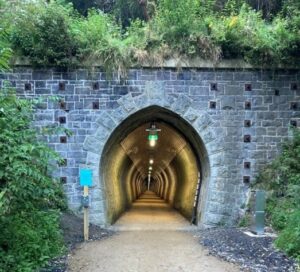
The 2026 Restoration Award was jointly presented to the Dunedin Tunnels Trail Trust and Dunedin City Council for the successful completion of the Chain Hills Tunnel project, Section One of the Mosgiel to Dunedin cycle trail and walkway. The project highlighted the adaptive reuse potential of old rail infrastructure and preserved a significant piece of rail heritage dating back to the development of New Zealand’s rail network in the mid-1870s.
Gerard Hyland, who first championed the cycle trail idea in 2005, accepted the award on behalf of both organisations at the FRONZ Conference held in Auckland over King’s Birthday weekend 2026. The Restoration Award also recognizes the efforts of the local community who long advocated for and supported this outcome.
Together with Caversham Tunnel (originally Lookout Point Tunnel), Chain Hills Tunnel was bypassed in the early 20th century when new double-tracked tunnels were opened as part of a railway duplication project between Dunedin and Mosgiel. The idea of a cycle trail through Caversham Tunnel was first advocated in 2005, but the Dunedin City Council gated it off in 2007. Efforts to have it reopened as part of a cycle trail to Mosgiel via Chain Hills Tunnel began in earnest in 2008 and the Dunedin Tunnels Trail Trust was established in 2009 to work in partnership with the council.
Thanks to community support and a major fundraising effort, Dunedin City Council purchased the Wingatui end of Chain Hills Tunnel via the Dunedin Tunnels Trail Trust in 2017. In anticipation of NZTA Waka Kotahi contributing half the funding, design work for a cycle trail between Caversham and Mosgiel began in 2020. When NZTA Waka Kotahi declined the application in 2024 DCC decided to proceed on its own and allocated $1.8 million funding to Section One, the 1.5km trail through Chain Hills Tunnel.
With Fulton Hogan as lead contractor site works began in June 2025. The side drains inside the tunnel had to be cleared, the base cleaned and resurfaced, the brickwork lining stabilised and repaired, and lighting installed throughout. Outside works included repairs to the portals, vegetation removal, the provision of a new access track off Gladstone Road North, fencing, planting, and signage.
When Tourism and Hospitality Minister Louise Upston visited the nearly completed project in November 2025 she announced $2 million of government funding to help extend the cycle trail towards Green Island. After 20 years of community effort Chain Hills Tunnel, Section One of a Mosgiel to Dunedin cycle trail, opened on 19 December 2025.
The history of Chain Hills Tunnel
The tunnel was bored as part of the Dunedin and Clutha Railway, the first sod of which was turned by the Governor of New Zealand, Sir George Bowen on 18 March 1871. Intended to be part of the Southern Trunk Railway, the 82 km route between Dunedin and Balclutha was divided into a series of construction contracts with major British railway construction company, John Brogden and Sons, being awarded the Taieri Contract in July 1872 a with a tender of £142,000. The contract, the longest on the route, called for the construction of 55km of formation from Green Island to south of Milton together with bridges and a 473-metre tunnel under the Chain Hills between Fairfield and Wingatui. Brogden’s subcontracted the tunnel job to Edmund Duxbury in September 1872 and the following month work began on erecting Camp No.1 on a site near the Dunedin side of the hills. This construction camp housed some of the men working on the tunnel.
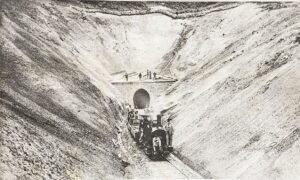
Major earthworks were needed on both sides of the Chain Hills to access the tunnel site. Rotten bluish schist that turned into slush when wet caused large slips to come down in the 1.6km cutting leading to the Dunedin portal, delaying a start on the bore at that end. With the aim of opening working faces at two points along the tunnel alignment Duxbury sunk two vertical shafts, one either side of the hill. Both were eventually completed, but the unstable geology meant neither served their intended purpose. They subsequently proved useful as ventilation outlets as work processed on the bore.
Boring started at the Taieri end first. Alternate seams of hard rock and clay were soon encountered, heavy timbering having to be erected as close as possible to the workface to prevent rockfalls. Some sections of the bore were going to be lined with bricks, but as work progressed it became apparent the tunnel would have to be brick-lined throughout Duxbury advertised tenders to make 100,000 bricks in February 1873 and these were laid to a depth of 36cm increasing to 46cm in softer ground. To avoid any delay in their delivery large brick kilns were established at each end of the tunnel.
In November 1873 the Government announced it had offered Brogden a bonus of £800 per month for every month saved completing the railway prior to 1 September 1875. By the end of the month the railway south of Dunedin had been completed to a point 1.5 km past Green Island and a junction was installed with the Dunedin and Port Chalmers Railway at the beginning of December. The first train to travel from the port to the Chain Hills tunnel site ran on 6th.
By then less than 200 metres of the tunnel had been completed. The bore at the Dunedin end was only a short distance in but work had progressed faster at the Taieri end where bricklayers were lining the bore only a matter metres behind the tunnellers. An hour later some two tonnes of bluestone fell from the tunnel roof instantly killing Patrick Dempsey and Thomas Kerr. Dempsey had only started work that morning while Kerr, the foreman, left behind a widow and seven children. Two others, Frederick Turnidge and Thomas Wedlake, were trapped under the fall. Wedlake escaped with a broken leg, but Turnidge’s injuries left him a cripple.
Despite the introduction of new machinery and shifts, the unstable geology delayed hole-through until 31 May 1875. The last rail was laid inside the tunnel on 18 August and with the rest of the line already completed, the Dunedin and Clutha Railway was officially opened on the date stipulated by the government’s bonus offer, 1 September 1875.
The tunnel later became part of the Main South Line of New Zealand Railways and retained that honour until bypassed on 1 June 1914 with the opening of the new double-track Wingatui Tunnel and deviation. In July 1914 the Government acquired land at the Wingatui end of Chain Hills Tunnel for use a temporary explosives magazine and the site was used for that purpose until the mid-1970s.
The landowners then granted locals informal use of the tunnel and it became a popular walking and horse-riding route between Wingatui and Fairfield. A sewer for the Fortex meatworks was laid through the tunnel in 1984, but it became redundant ten years later when Fortex entered receivership. The tunnel was gated shut by the Dunedin City Council in 1998 and a decade would pass before the idea of using it as a cycle trail and walkway gained momentum.